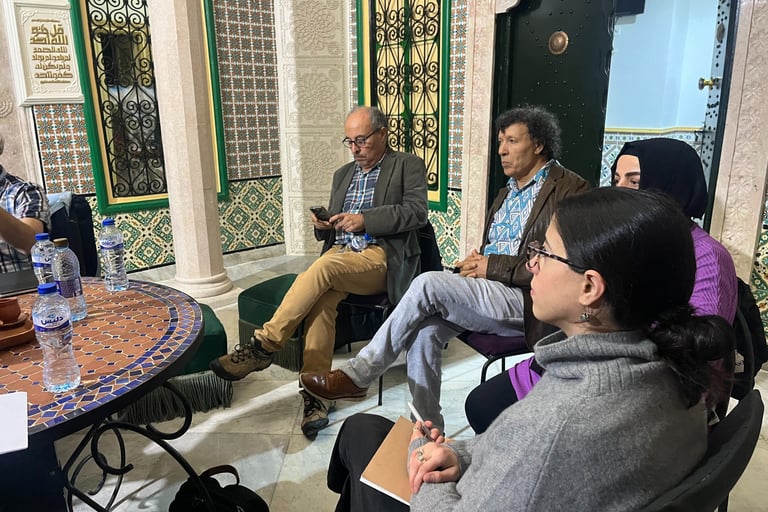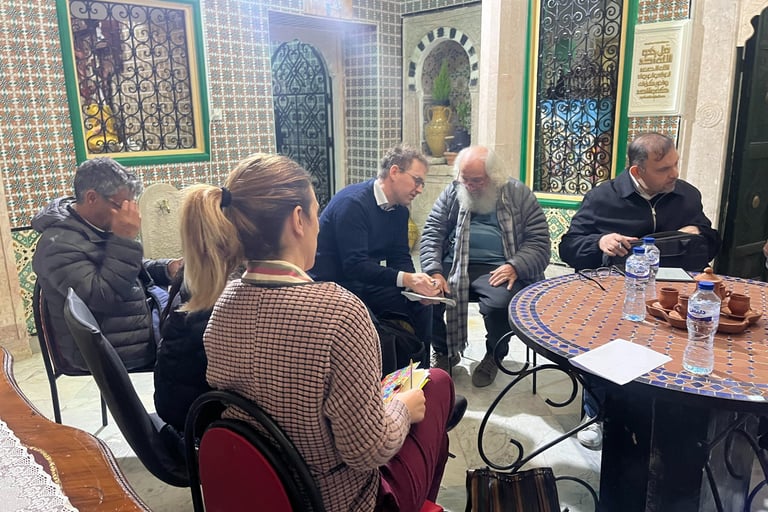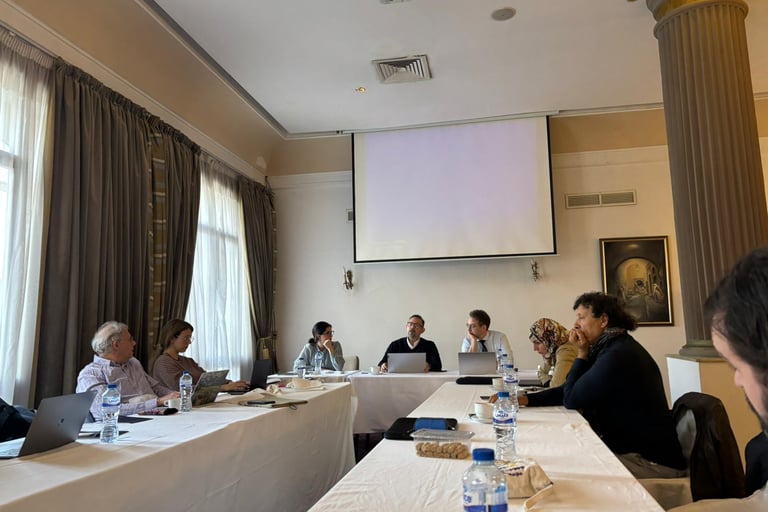
The workshop organized by the Arab Democracy Study Group formed part of a broader, long-term effort to foster sustained scholarly exchange on political regimes, authoritarianism, democratization, and protest politics in the Middle East and North Africa (MENA). Rather than a standalone event, the meeting built on previous discussions within the network and aimed to further consolidate ADSG as a forum for cumulative and comparative research on political change in the region.
The event brought together senior scholars and early-career researchers from different disciplinary backgrounds, including political science, international relations, sociology, history, and international law. Participants were based across Europe, the Middle East, and North America, reflecting the transregional character of the network. In addition to academic researchers, the meeting also incorporated perspectives from actors with direct experience of political and social engagement in the region, thereby encouraging dialogue across academic and non-academic boundaries.
The program was structured around a series of thematic panels combining theoretical, comparative, and empirical approaches. Discussions focused in particular on:
· post-2011 transformations of authoritarian regimes
· the limits and ambiguities of democratization processes
· the role of protest movements
· the changing position of the military and security apparatuses.
· the relationship between universal norms of international law and their selective application in political practice
· how global and regional dynamics shape domestic political trajectories.
Several panels engaged in depth with Tunisia as a key empirical case, examining recent political developments, transformations of protest dynamics, and the evolving relationship between state institutions and society. Other discussions addressed Palestine and broader regional contexts in North Africa and the Eastern Mediterranean, enabling participants to situate individual cases within wider comparative frameworks. Across panels, participants emphasized the importance of moving beyond institutional analyses to capture everyday mechanisms of power, control, and resistance.
A distinctive feature of the workshop was its emphasis on open-ended and critical exchange, rather than the pursuit of definitive conclusions. Democratization was repeatedly discussed not as a linear or technocratic process, but as a contested and long-term dynamic shaped by interactions among local, regional, and global actors. This shared analytical perspective allowed individual contributions to be linked into a broader debate on the nature of contemporary political regimes and the persistence of authoritarian governance in the MENA region.
Beyond the immediate discussions, the workshop also served as a platform for strengthening research networks and initiating future collaboration. Participants explored possibilities for joint research projects, comparative work, and future publications emerging from the themes discussed during the meeting. In this sense, the meeting functioned not only as a space for presenting ongoing research, but also as an incubator for continued scholarly dialogue and cooperation within and beyond the Arab Democracy Study Group.