Resilience from Below:
Local Knowledge and Governance among Oyster Farmers in Kesennuma, Japan
Kano Konda
31 May 2026
What is being tested in this modern age of uncertainty is how we can transform crises and upheavals into positive change. People refer to this process of facing such challenges as “resilience.” In this brief essay, I examine the nature of good governance in resilience, drawing on experiences from the site of the Great East Japan Earthquake and Tsunami, which occurred 15 years ago at the same time as the Arab Spring. What kind of perspective emerges when the post-Arab Spring era crosses paths with Japan’s post-disaster practices?
The Intersection of 3•11 and the Arab Spring
In 2011, at the very same time that societies across the Middle East were undergoing dramatic change, Japan’s north-eastern coast was struck by a historic disaster: the Great East Japan Earthquake and the Tsunami, commonly known as 3•11 (san-ten-ichi-ichi) in Japanese. Kesennuma, the focus of this paper, is a small fishing port city on the east coast and one of the areas that suffered the worst damage from the tsunami.
Interestingly, it is not as though these two events never intersected. In Egypt, the African Club Championship—the first international football match since the revolution—was held on March 18th, during which the Japanese flag was displayed at Cairo Stadium with the message “Our hearts are with Japan” (Kawakami 2021). Later that year, the University of Tokyo hosted an international symposium that drew parallels between Egypt’s January 25th Revolution and 3•11. Indeed, the revolution and the tsunami shared a common feature: the visualization of absurdity, the forced suspension of daily life, and the collapse of the order people had taken for granted. When forces beyond our control threaten and toss about our dignity, in Tunisia, Mohammed Bouazizi made his plea through a death by fire. His hogra must have resonated with the despair felt in Japan, as one of my informants from Kesennuma recalled that, in the immediate aftermath of the tsunami, people felt there was “neither God nor Buddha.”
What surprised me in Kesennuma was, however, the reconstruction slogan adopted by this city, one of the hardest-hit areas, was “Stay with the Ocean (Umi-to-Ikiru)”. This slogan was adopted as the title of the Kesennuma City Reconstruction Plan, which was drafted by the Policy Planning Division of the Development Department of Kesennuma City in October 2011. On the day of the tsunami, people witnessed the black streams of the ocean swallowing their homes, families, and friends. Nevertheless, why did people make “Stay with the Ocean” their top priority? What exactly does this concept of resilience entail in knowledge and practice?
The Major Overhaul of the “Oyster G-Men”
Although I am a cultural anthropologist specializing in Tunisia, I had an opportunity to conduct 3 days of fieldwork in Kesennuma City from February 22nd to 24th this year, as part of an initiative to bridge academic ties between Japan and Africa. I visited the northeastern part of Kesennuma, where the Karakuwa Peninsula lies. In this region, characterised by the rias coastline unique to the region, the sea quietly flows into deep valleys carved by rivers, with layers upon layers of inlets and bays creating a complex coastline. The waters off the Karakuwa coast have long been known as a rich fishing ground. It has nurtured generations of deep-sea fishermen, including those practising the 350-year-old tradition of single-line bonito fishing.
Today, the aquaculture of scallops, oysters, and wakame seaweed is also thriving, and the bay is dotted with aquaculture rafts bobbing gently on the water. As of 2016, five years after the earthquake, the Karakuwa Branch of the Miyagi Prefecture Fisheries Union had a total of 931 members, comprising 455 full members and 476 associate members. Of these, 60 per cent were engaged in aquaculture.
Along the west coast of the peninsula, I met Mr. Masanori Hatakeyama, an oyster fisherman from a family that has been in the trade for four generations. He once served as the branch chairman and is now affectionately known as “the boss” by the staff at his oyster farm. It was he who led the self-styled “Oyster G-Men” project, which brought about a major overhaul of the Karakuwa fishing industry in the aftermath of the earthquake.
“I was chairman of the cooperative’s distribution center for 13 years, but I stepped down six years ago. Now I’m just an old man. If I go around mentioning my name, people might call me a ‘troublemaker,’”
He told me with a sheepish grin. With his shaved head and stocky build—not particularly tall, yet commanding a certain presence—his white teeth stood out against his tanned skin. Though he called himself an “old man”, he radiated a youthful vigor.
The catalyst for the formation of the Oyster G-Men was none other than that earthquake and tsunami. A massive tsunami, reaching heights of over 10 meters, swept through the Karakuwa area. They lost almost everything: not only their farmed produce, but also their fishing boats, aquaculture rafts, fishing gear such as ropes, the communal processing plant on land, and heavy machinery like forklift trucks. The factory, inherited from three previous generations, and the oysters they had painstakingly nurtured over three years, were all swallowed up, leaving nothing but a mountain of rubble.
Fortunately, the fishermen, including Mr. Hatakeyama, had evacuated to the open sea in their own boats, and 20 vessels—about 80 per cent of the pre-disaster fleet—escaped being swept away (Sato 2025: 51). “If you escape to a depth of 100 meters, the water won’t reach you. The fishermen from the Karakuwa Peninsula were the first to head out to sea that day,” Mr. Hatakeyama told me, recalling the day. In fact, historically, tsunamis have not been uncommon in this region. The knowledge of these seafaring men, gained from experience, is what saved their ship, their most valuable asset.
However, it is also true that the sheer scale of the devastation left even these hardy fishermen on the brink of despair. For a while, all the fishermen were kept busy clearing rubble and rebuilding their lives. During that time, it was the CEO of the oyster supplier—with whom Mr. Hatakeyama had built a relationship of trust—who offered him words of encouragement. “Please don’t give up on oyster farming.”
In August, he gathered the oyster farmers and declared, “I am about to make a bombshell announcement.” According to an interview by former journalist Norio Sato, he went on to say the following.
“We will not engage in, nor allow, the kind of disorderly and self-serving farming practices of the past. We will produce high-quality oysters that enhance the reputation of the Karakuwa brand. Those who lack this commitment must leave.” (Sato 2025: 53)
This marks the launch of “Oyster G-Men.” Before the disaster, the oyster farming industry faced the problem that transactions were generally conducted individually with each supplier, leading to a lack of transparency and the tacit acceptance of malpractice. There were even cases where oysters imported from South Korea were sold nationwide under the “Produced in Kesennuma” label.
He worked tirelessly to prevent the fraud that had become rife in the oyster farming industry, to standardize practices, and to ensure transparency. He did not merely issue warnings. First, he sought to strengthen cooperation between the Union members. Mr. Hatakeyama frequently gathered oyster farmers to standardize aspects such as the length and spacing of the ropes suspended from the rafts.
He then introduced a system whereby all oyster shipping containers were made transparent and managed with barcodes on each individual box. The transparent containers were intended to demonstrate an attitude of honesty and transparency; furthermore, to prevent fraud, they were designed so that any tampering would be immediately apparent once opened.
Naturally, there was strong opposition from among the fishermen. This was because implementing such reforms meant admitting their past mistakes and effectively exposing them to public scrutiny. “It was certain to become a major scandal across Japan. My colleagues asked, ‘What will we do if the oysters stop selling?,’ and we discussed it time and again,” said Mr. Hatakeyama.
“Why were you able to shoulder such a risk?” When I asked Mr. Hatakeyama, he paused for a moment before stating with a refreshingly resolute tone, “I felt compelled to ask myself: ‘Is this something I can pass on to my grandchildren? Can I really just turn a blind eye and let things continue as they are?’”
The Philosophy of Tossed Oysters
The Oyster G-Men, organized by Mr. Hatakeyama, revolutionized oyster farming on the Karakuwa Peninsula. His approach was, in fact, interwoven with a philosophy he had learnt from oysters during his many years of farming them.
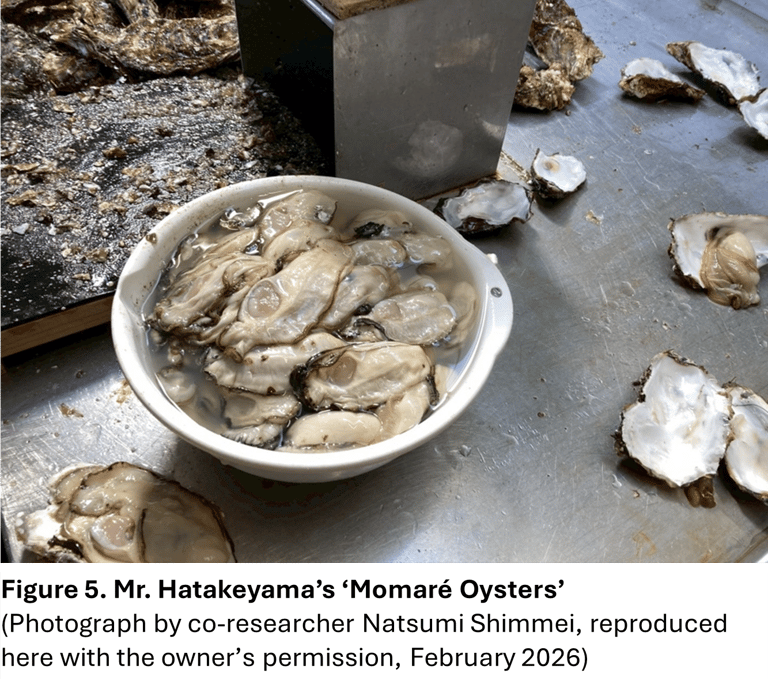
The oysters Mr. Hatakeyama cultivates are not the usual 5–6 cm but are literally palm-sized. The waters off the Kesennuma coast are a zone where a warm current, rich in the minerals that build oyster shells, meets a cold current containing 10 times the plankton needed to nourish the oysters’ flesh. Mr. Hatakeyama and his team have utilized this unique environment to develop a method of cultivating oysters over three years, resulting in specimens with the thickest adductor muscles and the plumpest flesh.
Mr. Hatakeyama swiftly shucked several freshly harvested oysters with a knife, then looked at me and nodded as if to say, “Choose whichever you like and eat.” As I popped an oyster into my mouth, the scent of the sea filled my senses, and the fresh, creamy flesh burst with flavor. He watched our reaction with warm satisfaction and began to speak.
“Oysters are a bit like humans. The sea is harsh, but in the end, it’s the sea that saves us.”
He continued:
“For the first two weeks after hatching, the oysters drift in the water, searching for a scallop shell to attach themselves to. Once they’ve found a good home and settled in, they spend a year growing in a calm cove. After a year—just as humans enter society and are tested by it once they reach adulthood—they do the same. We take them out to the rougher waters offshore to let them grow there. In September, we immerse them once in 70-degree water to remove any excess plankton or dirt clinging to their shells. Then we return them to the rough waves. That’s why the oysters here are called ‘Momaré Oysters’. It means they’re finished off in a harsh environment.”
In Japanese, “to be tossed about” (momareru) means to be pushed with great force or jostled about; by extension, it describes the process of growing through the hardships experienced within society or a group. Underlying his “tossed-about oyster” philosophy is a way of life in which one is thrown into the maelstrom of powerful forces, constantly reflecting on oneself and making course corrections whilst being buffeted by the waves. The “Momaré Oyster” philosophy—becoming stronger through being tossed about—lay at the very heart of Mr. Hatakeyama’s practice of “Stay with the Ocean.”
Local Knowledge and Governance
Mr. Hatakeyama’s story, as described above, brings to mind the concept of local knowledge proposed by Larabi Sadiki. In the context of the Arab Spring, he seeks the conditions for good governance in local knowledge systems. Here, the term “local” speaks to “locality and specificity in the assimilation, application and interpretation of ideas, values, morals, myths, symbols and the technologies they necessitate” (Sadiki 2015: 703-704). “This system or repertoire, called in Arabic makhzun, which people adaptively and inter-generationally transmit and supplement as they manage change over time and space, is integral to the identity template of society as a whole” (Sadiki 2015: 704).
During the reconstruction process following the 3•11 disaster, a disconnect emerged between government-led reconstruction and local lived experiences, a phenomenon reminiscent of the stalled democratic transitions in the Middle East. Such a legacy remains deeply entrenched to this day. In the disaster-stricken areas, in addition to the national reconstruction budget, donations and volunteer support from both within and outside the country converged, temporarily creating an economic boom known as the “disaster bubble.” (This expression draws its name from the historic economic boom in Japan from the late 1980s to the early 1990s, known as the “bubble” era). A new shopping mall was built around Kesennuma Station, and the town regained its vibrancy. However, the exodus of the population continued unabated, and the problem of maintaining the local community itself remained unresolved.
Ethnographic research conducted by Japanese researchers between 2011 and 2012 highlights the limitations of this reconstruction from the perspective of rebuilding local communities (Takakura & Takizawa 2012). In the post-disaster, government-led policy on temporary housing, priority was given to the rapid reconstruction of lost homes and infrastructure and to securing the minimum living standards for the people. This was an essential response to ensure survival. However, this approach did not sufficiently take into account the importance of geographical ties and family ties to people. For example, temporary housing units lacking space for a Buddhist altar were not recognized as ie—the Japanese household that had served to honour ancestors and maintain kinship ties.
Symbolizing this, in one settlement in Kesennuma City, people reportedly undertook the restoration of a shrine where ancestors had been worshipped for over 200 years before rebuilding their homes (Umeya 2014: 53-55). For them, reconstruction was not merely a matter of restoring the practical functions of daily life, but also an endeavor to reconnect the continuity of the community inherited from their ancestors with the next generation. Such examples demonstrate that whilst government-led reconstruction policies relied on a “linear” concept of resilience, aiming directly for the restoration of infrastructure and the economy, a different logic of reconstruction existed within local communities, one that encompassed the preservation of memory, ancestral rites, and the continuity of human relationships.
This is precisely why the practices of the Oyster G-Men hold such significance. Their activities redefined the crisis not merely as an abnormal situation to be restored to its former state, but as an opportunity to move to the next stage; it was an initiative to forge a better future whilst casting a reflective gaze upon themselves through civic power. Rather than being prompted by the administration, they questioned for themselves what gave rise to corruption and how profits could be distributed more equitably, whilst confronting the backlash from those seeking to reinforce traditional practices through dialogue.
Furthermore, the gaze of the Oyster G-Men extends beyond immediate reconstruction to the descendants who will live centuries from now. Mr. Hatakeyama’s son has inherited his father’s philosophy and serves as chairman of the young fishermen’s association. Moreover, to pass on the philosophy of “Momaré Oysters” to the next generation, Mr. Hatakeyama has launched an oyster farming experience project in collaboration with a local public primary school. Each class is entrusted with a cultivation raft, experiencing the process of planting in the first year, nurturing in the second, and harvesting in the final year. Through this, they physically learn the very sense of time that comes from living in harmony with the sea.
Underlying these practices is a sense that, no matter how great the adversity, the relationships they have protected and sustained must not be severed. The sense of “steering one’s own course through change” is not about discarding the past to create something new, but is underpinned by the endeavor to revitalize what has been handed down to us in a different form. Mr. Hatakeyama’s story demonstrates how the knowledge and philosophy accumulated at the local level can provide a powerful yet flexible force in the reconstruction of good governance.
There is a striking phrase I learnt from a taxi driver in Kesennuma. Iriko-sumako is a word in the Kesennuma dialect that refers to the far corner of a space, conveying the sense of something that penetrates deep within, much like a cove. It is precisely this iriko-sumako perspective, nurtured by the sea and the people of Kesennuma, that is so important. Moreover, this type of governance is not merely a matter of following conventional paths. Like “Momaré Oyster,” it is nurtured through a cycle of being tossed about and nurtured by the Pacific Ocean, then returning to the land once more.
Acknowledgements
I am deeply grateful to the people of Kesennuma, particularly Mr. Masanori Hatakeyama, who generously shared their experiences with me. The fieldwork was carried out in collaboration with the African Conviviality Center, Kobe University. I wish to acknowledge the organizer, Professor Kiyoshi Umeya, as well as co-participants Dr. Eria Olowo Onyango, Dr. Chris Columbus Opesen, Dr. Stevens Aguto Odongoh (Makerere University), Dr. Minga Mbweck Kongo (University of Cape Town), Dr. Yushi Yanohara, Ms. Natsumi Shimmei, and Mr. Fumiya Shinotsuka.
References
Kawakami, Y. 2021. ‘10-nen mae no 3-gatsu 18-nichi, Kairo de Hasshin Sareta Shinsai-go no Nihon e Gekirei no Ēru / Nihonjin ga Miteinai “Arabu no Haru”’, Yahoo! News, 18 March. Available at: https://news.yahoo.co.jp/expert/articles/0f4a632f464bdda5b083c74998bd679
aa75fca88 (Accessed on May 9, 2026).
Kesennuma Fish Market 2026. Available at: https://kesennuma-uoichiba.jp/info/74/ (Accessed on May 17, 2026).
Sadiki, L. 2015. Towards a ‘Democratic Knowledge’ Turn? Knowledge Production in the Age of the Arab Spring, The Journal of North African Studies 20(5): 702-721.
Sato, N. 2025 Minato-machi Kisha no Sotsuron: “Kesennuma-bito” to-no Naki Warai Kenbunroku [A Port Town Reporter’s Thesis: A Chronicle of Laughter and Tears with the People of Kesennuma]. En Publication, Originally in Japanese.
Suzuki, Y. 2016. Karakuwa no “Umi” to Ikiru: Hama no Kaachan no Ba! Ba! Ba! na Katsudō [Staying with the Ocean in Karakuwa: The Dynamic Activities of Hama no Kaachan]. JF Zengyoren Report, Originally in Japanese.
Takakura, H. and K. Takizawa (eds.) 2012. Higashi Nihon Daishinsai ni Tomonau Hisai shita Minzoku Bunkazai Chōsa: 2012 Nendo Hōkokusho Bessatsu [Survey of Folk Cultural Properties Damaged by the Great East Japan Earthquake: 2012 Report, Supplementary Volume]. Tohoku University Center for Northeast Asian Studies, Originally in Japanese.
Umeya, K. 2014. Sūhyakunen-go no Nenjū Gyōji o Uranau Komichi [A Path that Foretells the Annual Festivals of Centuries to Come], Kikan Minzokugaku 148:46-55, Originally in Japanese.
The views expressed or implied in this article are solely those of the author and do not necessarily reflect the views or positions of Demos Tunisia-Democratic Sustainability Forum.
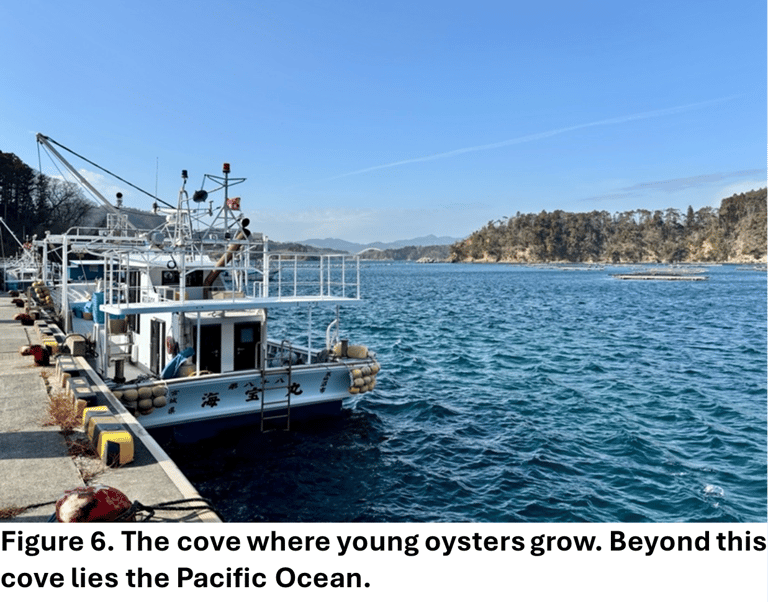
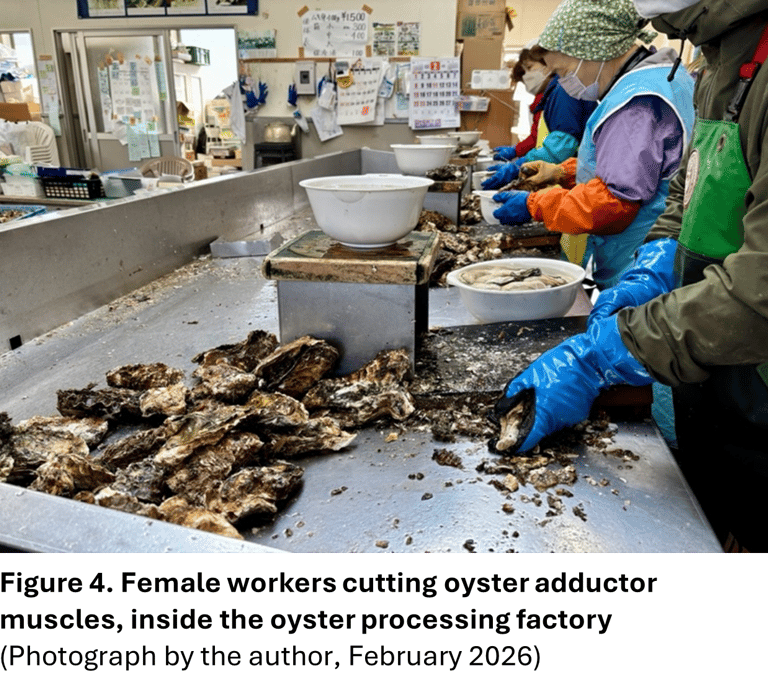
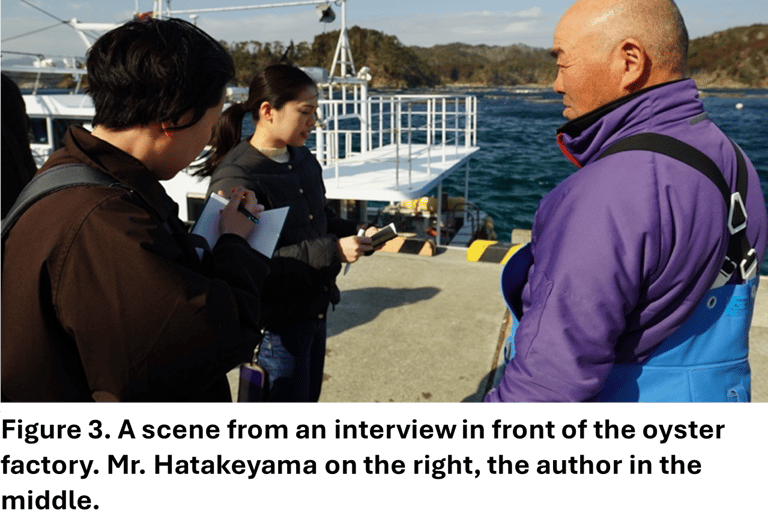
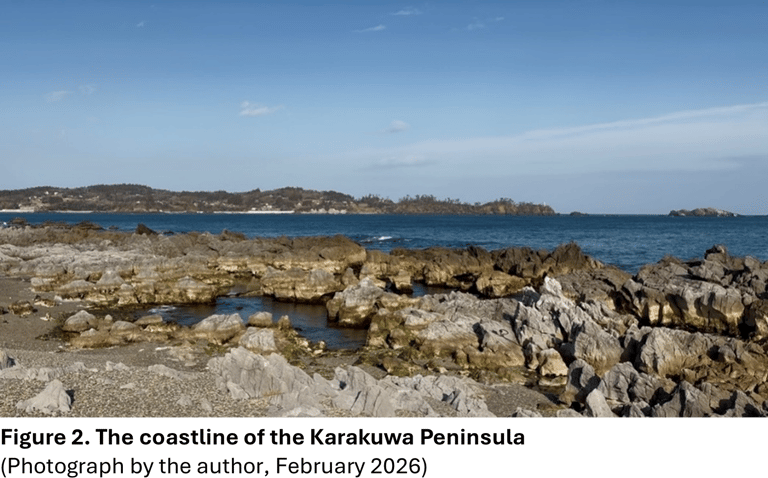
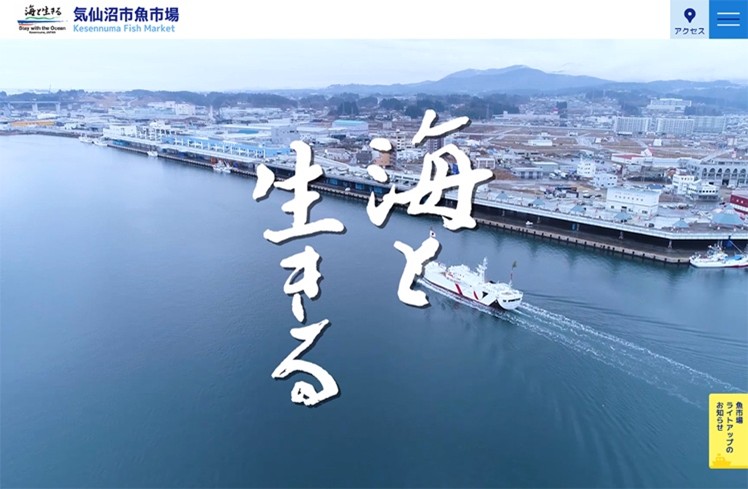
Figure 1. The Slogan "Stay with the Ocean", the cover image of the Kesennuma Fish Market's official website (Kesennuma Fish Market 2026)